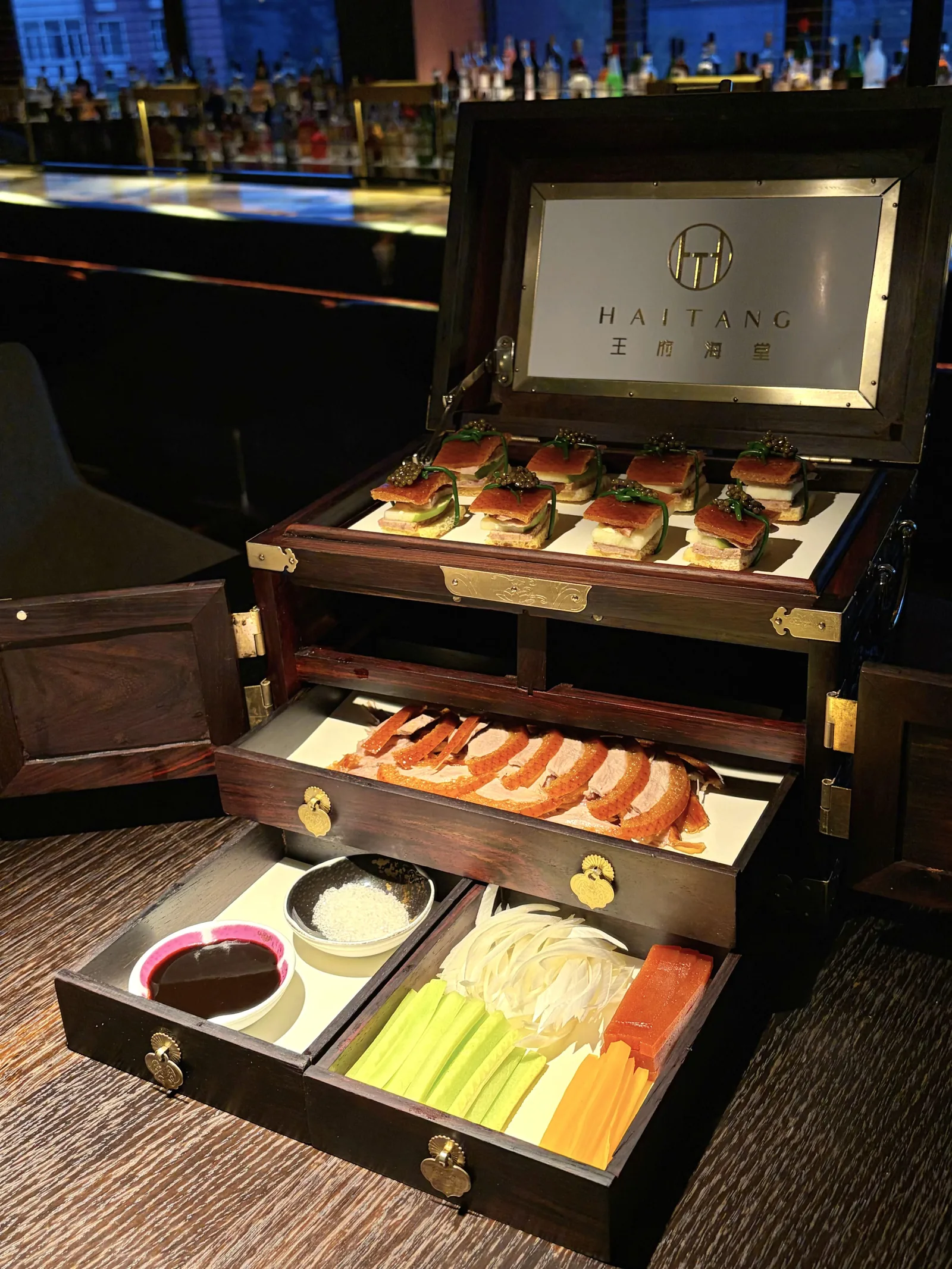
Peking duck is Beijing’s signature dish: a whole roast duck carved into slices of crackling skin and tender meat, which you wrap in thin pancakes with scallion, cucumber and sweet bean sauce. Quanjude made its name with hung-oven duck roasted over a jujube-wood fire, and Bianyifang still uses the older closed oven.
- Classic hung-oven duck: Quanjude, founded 1864; original restaurant at 30 Qianmen Dajie
- Classic closed-oven duck: Bianyifang, which traces its history to 1416
- Michelin-starred duck: Gastro Esthetics DaDong, Dongsi 10th Alley
- How to eat it: duck, scallion and sweet bean sauce rolled in a thin pancake
- Other Beijing classics: zhajiangmian noodles, copper-pot mutton hot pot, douzhi, tanghulu
A short history of Peking duck
Roast duck came to Beijing from Nanjing in the early 1400s, when the Ming court moved north under the Yongle Emperor. The older of the two roasting methods is the Ming-era closed oven, and Bianyifang traces its history to the 14th year of the Yongle reign, 1416. Its closed-oven technique was added to China’s national intangible cultural heritage list in 2008.
The hung oven came later, in the Qing dynasty, and Quanjude made it famous. Quanjude was founded in 1864, and its first restaurant, the Qianmen branch at 30 Qianmen Dajie, is still serving duck; in 2025 it also had a 16-seat 3D immersive dining room. The craft is described in four stages: scalding, preparing the duck, roasting and finally carving, the part you see at your table.
Hung oven or closed oven?
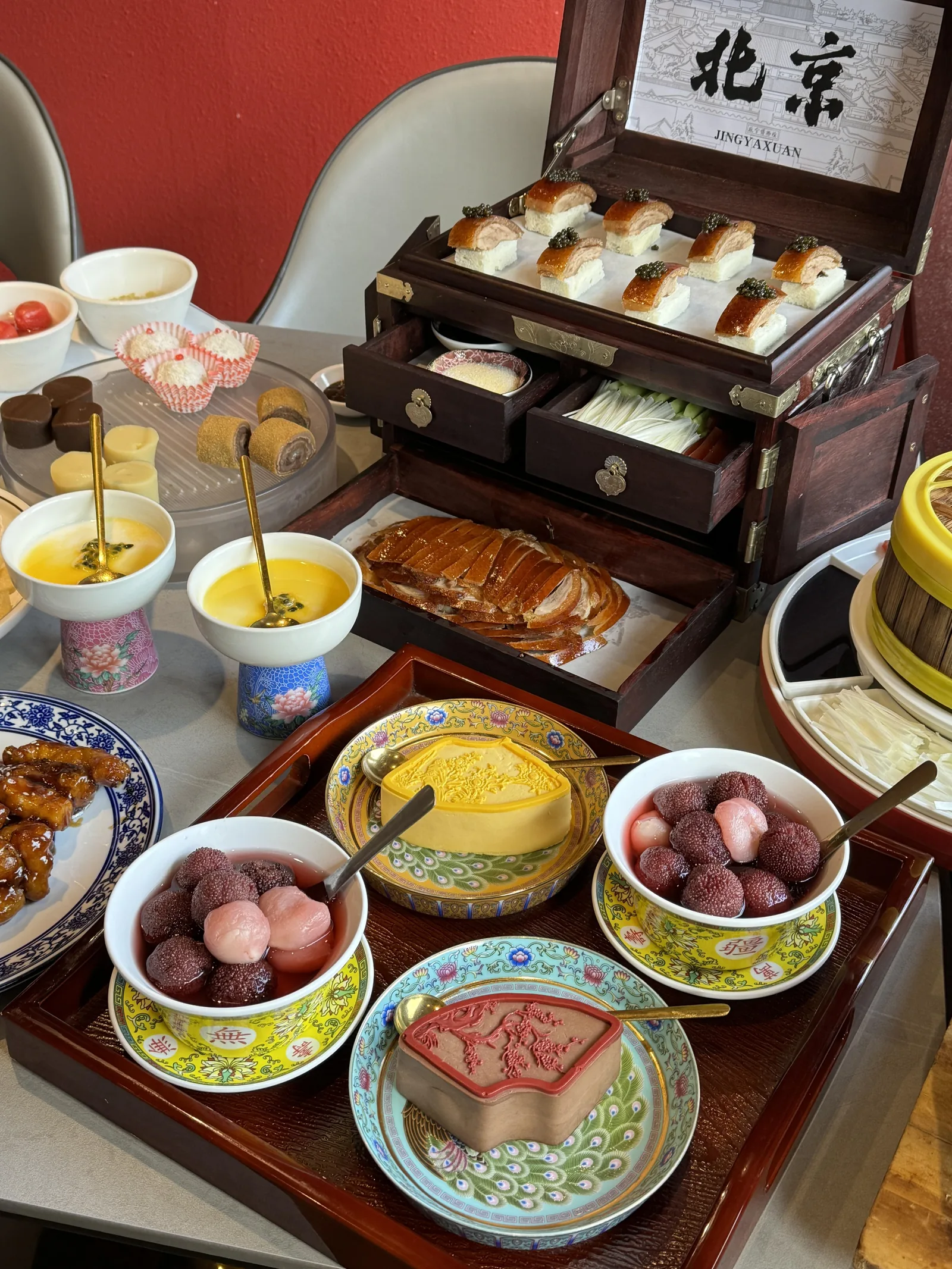
The difference comes down to whether the duck ever meets a flame.
- Hung oven (gua lu): the duck hangs inside an open-flame oven fed with jujube wood and roasts for about 45 minutes. The skin picks up a faint, sweet smoke from the fruit-wood fire. This is the Quanjude style.
- Closed oven (men lu): the oven is heated first and the duck roasts in the stored heat, so it never meets an open flame. Bianyifang keeps this older method alive.
If you have two dinners free, try one of each. Pay attention to the skin; the hung-oven duck carries a faint smoke from the jujube wood.
How to eat Peking duck
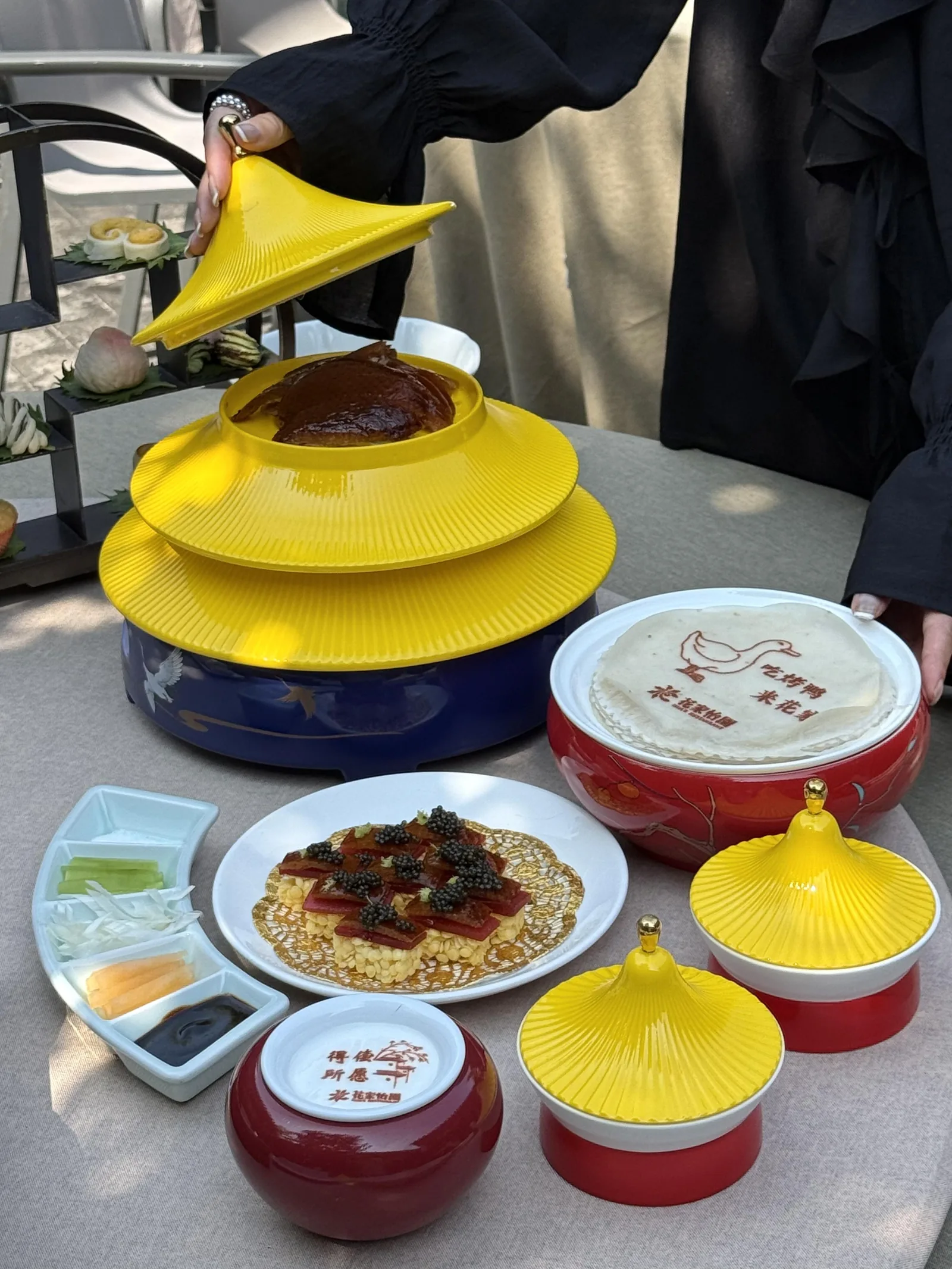
At many duck restaurants the carving is part of the show; at Da Dong, for example, the chef carves at your table. Then you roll your own:
- Lay a thin “lotus-leaf” pancake flat on your plate.
- Brush on a little sweet bean sauce, or dip the duck in it.
- Add a few slices of duck and some shreds of scallion.
- Fold in the bottom, roll it up and eat it with your hands.
Traditionally the pancake held only duck and scallion, with cucumber strips eaten between rolls to refresh the palate. Many restaurants now serve cucumber for rolling too, so do whichever you enjoy. Travelers report that a half duck is often on the menu, which is plenty for one or two people. Some restaurants, Da Dong among them, also bring the crisp skin with a little white sugar for dipping. It sounds odd and tastes wonderful.
Where to eat Peking duck in Beijing
| Restaurant | Known for | Where |
|---|---|---|
| Quanjude Qianmen | The original hung-oven duck | 30 Qianmen Dajie, Dongcheng |
| Bianyifang | Closed-oven duck | Chaoyang Park branch, Tianshuiyuan Beili |
| Gastro Esthetics DaDong | One Michelin star; modern duck | 22A Dongsi 10th Alley, Dongcheng |
| Siji Minfu | Views toward the Forbidden City | 11 Nanchizi Dajie, Dongcheng |
Quanjude Qianmen, the group’s first restaurant, still roasts its ducks in the hung oven. Bianyifang has several branches; its Chaoyang Park branch is on the 4th floor of Building 16, Tianshuiyuan Beili. Gastro Esthetics DaDong, Da Dong’s flagship in the Nanxincang Business Tower, holds one Michelin star in the 2027 selection; the Michelin Guide notes it roasts 22-day-old ducks and serves them with pancake, cucumber, scallion, minced garlic and bean sauce. Siji Minfu has several branches, and the one on Nanchizi Dajie looks toward the Forbidden City’s corner tower and East Glorious Gate. Travelers in 2026 report long waits there at peak lunch and dinner times, so arrive at opening time or plan a late lunch.
Prices and booking rules change often, so we check them for your dates rather than print them here.
Tell us your dates, group size and what you would like to see. We reply with a day-by-day plan and a written quote.
Beyond duck: Beijing dishes to try
- Zhajiangmian: chewy noodles with a sauce of fermented soybean paste and stir-fried minced pork, tossed at the table with a spread of fresh, seasonal vegetables, often ten or more. Vegetarian egg-and-vegetable versions exist.
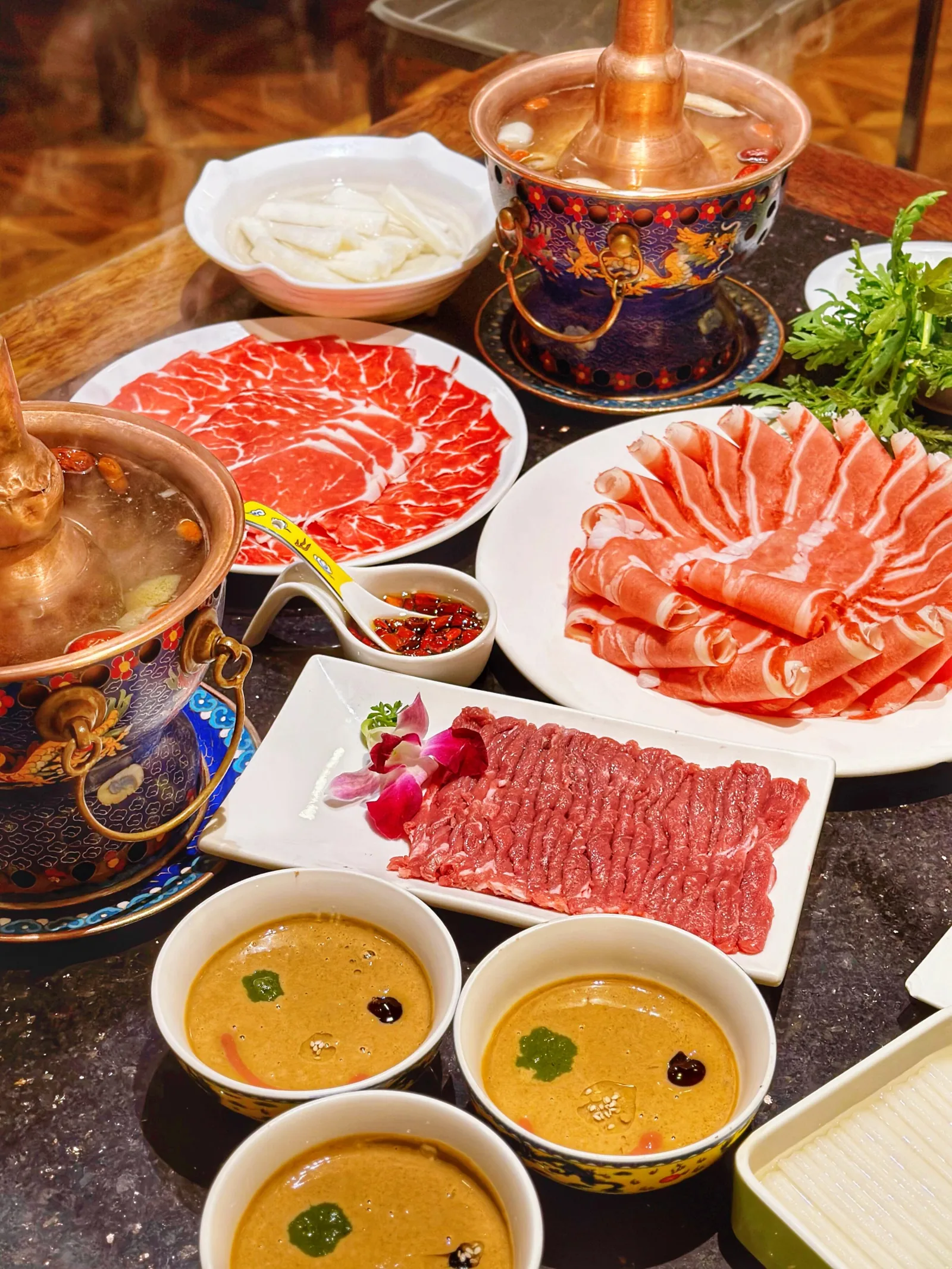
- Shuan yangrou (copper-pot mutton): Beijing’s own hot pot, a light broth in a copper pot, paper-thin mutton swished for a few seconds, with Chinese cabbage, tofu and glass noodles. Donglaishun, a halal restaurant founded in 1903 at the north gate of Dong’an Market on Wangfujing, and Yitiaolong, founded in 1785, are two famous names; Yitiaolong’s halal technique is on Beijing’s municipal intangible heritage list.
- Shaomai at Duyichu: Duyichu, founded in 1738, pinches each shaomai into 24 pleats, and its craft is on the national intangible heritage list (2008).
Beijing snacks
Beijing’s snacks are the food of breakfast stalls and hutong corners. A few to look for:
- Douzhi with jiaoquan: a hot, sour, fermented mung-bean drink with about 300 years of history, sipped with crisp fried jiaoquan rings and shredded pickles: a sip, a bite, a pickle. It is an acquired taste, and Beijingers love it; the city’s douzhi custom joined Beijing’s intangible heritage list in 2007. Jinxin Douzhi, founded in 1958, is one of the names linked to it.
- Luzhu huoshao: pork offal and tofu stewed in broth with slices of huoshao bread, topped with garlic sauce. Xiaochang Chen’s version joined the municipal heritage list in 2014.
- Baodu and chaogan: quick-boiled tripe with sesame sauce, and chaogan, a breakfast stew of stir-fried liver.
- Zha guanchang: crisp fried starch slices with garlic water. It’s vegetarian.
- Lüdagun (“rolling donkey”): soft glutinous rolls filled with red-bean paste.
- Miancha: millet porridge with a swirl of sesame paste.
- Tanghulu: hawthorn berries on a skewer in a glassy sugar shell, sold year-round but best in winter, when the cold keeps the shell crisp.
- Something cool: old-Beijing yogurt in a white ceramic jar sealed with paper, or jasmine-tea and matcha soft-serve from the tea merchant Wuyutai on a hutong stroll.
Our Beijing evening food tour puts several of these on one walk, then sits you down to a Peking duck dinner with side dishes. For the lanes themselves, see our guide to Beijing’s hutongs.
Vegetarian and halal food in Beijing
Vegetarian: Gongdelin, founded in Beijing in 1984, was the city’s first restaurant to bring in pure-vegetarian cuisine. It cooks in the Yangzhou style and makes “imitation meat” from mushrooms, fungi and soy. Among the snacks, zha guanchang is vegetarian, and zhajiangmian comes in egg-and-vegetable versions. Peking duck restaurants usually have plenty of vegetable dishes too, so a mixed group can share one table. Tell us in advance and we plan vegetarian or no-spice options on our food tour.
Halal: Niujie (Ox Street) in Xicheng is the center of Beijing’s Hui Muslim community, built around Niujie Mosque, which is said to be about a thousand years old. The street has halal butchers, snack shops, beef pies, sesame shaobing, baodu and copper-pot mutton; Jubaoyuan has an English menu. Donglaishun, Yitiaolong and Man Heng Ji serve halal copper-pot mutton. Baodu, douzhi, lüdagun and miancha are generally halal; luzhu and chaogan are not. Look for halal certification at the door.
To plan the sightseeing around the meals, see things to do in Beijing or our private Beijing tours.
Tell us your dates, group size and what you would like to see. We reply with a day-by-day plan and a written quote.
Frequently asked questions
What is the difference between hung-oven and closed-oven Peking duck?
Hung-oven duck, the Quanjude style, hangs over an open jujube-wood fire for about 45 minutes and picks up a light, sweet smoke. Closed-oven duck, Bianyifang's older method, roasts in a pre-heated oven and never meets an open flame.
Where is the original Quanjude restaurant?
Quanjude's original restaurant is its Qianmen branch at 30 Qianmen Dajie, Dongcheng. Quanjude was founded in 1864 and still roasts its ducks in the hung-oven style there.
How do you eat Peking duck?
Lay a thin lotus-leaf pancake flat, add a little sweet bean sauce, a few slices of duck and some scallion, then roll it up and eat it with your hands. Cucumber is traditionally eaten on the side, though many restaurants now serve it for rolling too.
Which Peking duck restaurant has a Michelin star?
Gastro Esthetics DaDong, Da Dong's flagship at 22A Dongsi 10th Alley in Dongcheng, holds one Michelin star in the 2027 selection. The Michelin Guide notes it uses 22-day-old ducks.
Is there vegetarian food in Beijing?
Yes. Gongdelin, founded in 1984, was Beijing's first restaurant to bring in pure-vegetarian cuisine, with imitation meat made from mushrooms, fungi and soy. Zha guanchang and egg-and-vegetable zhajiangmian are good vegetarian snacks.
Where can I find halal food in Beijing?
Niujie (Ox Street) in Xicheng is Beijing's Muslim neighborhood, with halal butchers, snacks and copper-pot mutton. Donglaishun, Yitiaolong and Man Heng Ji serve halal hot pot. Baodu, douzhi, lüdagun and miancha are generally halal; luzhu and chaogan are not.
What Beijing snacks should I try?
Start with tanghulu, candied hawthorn on a stick; lüdagun, red-bean glutinous rolls; zhajiangmian noodles; and, if you're curious, hot douzhi with crisp jiaoquan rings. Our evening food tour includes tastings of several Beijing snacks and a Peking duck dinner.
Facts checked: 5 November 2026. Ticket prices, opening hours and entry rules can change; we re-check before every booking.